Saturday, October 3, 2015

SPX REPORT

LIFE, DEATH AND EVERYTHING IN BETWEEN featured Jennifer Hayden (Story of My Tits), Derf Backderf (My Friend Dahmer), and Frederik Peeters (Blue Pills). The conversation went through aspects of the autobiography, starting from the broad strokes of the genre to the practical parts of creating the material. The intricacies of autobiography were explored by the panelists, engaging with the complexities of universality, authenticity, portrayal, and its effectuation of narrative against real life.

"It's funny because I lived"


EUROPEAN COMICS AND THE ABSURD featured Joan Cornella, Bendik Kaltenborn and Brecht Vandenbroucke. The presentation started out with a depiction by one of the artists of the panelists fighting on stage, which set the tone perfectly for the discussion of the mood, tone and aesthetics of the artists’ work. The artists presented their work, discussing the navigation between editorial and personal pieces, the synthesis of their voice in their practice, and audience reception. 

SPX Report - Evangeline Gallagher

SPX Report

I attended two panel discussions at SPX. The first was “European Comics and the Absurd”, with Joan Cornella (Spain), Brecht Vandenbroucke (Belgium), and Bendik Kaltenborn (Norway) who were interviewed by Bill Kartalopoulos, the editor of Best American Comics. Bendik was involved with the Dongery collective and also does editorial illustration work, and talked about how he is able to successfully keep the silly/absurd nature of his comics in his editorial work. They discussed the political aspect of their comics, as well as how they began creating comics and their career. Joan Cornella expressed that he was heavily influenced by Brecht’s work, and all three artists mentioned that they were inspired by Herr Seele and Kamagurka’s work in the absurdist comic strip Cowboy Henk.

I also attended the panel “It’s a Small, Small, Small Press World”, with Lara Antal of So What? Press, Box Brown from Retrofit comics, Francois Vigneault of Study Group Comics, and Kevin Czap of Czap Books. This panel was moderated by Isaac Cates. Most of these small press publishers began as creators who decided they wanted to publish the work of others as well as their own. Study Group comics publishes a lot of webcomics, and Vigneault discussed the fact that this makes it easier to publish riskier or less well-known creators because you don't take any financial damage from unsold, printed copies. They also discussed what the right size is for a typical run of prints. All of the small press publishers in attendance expressed that it is very important to have a presence on social media, but they also made the point that popularity online has very little direct correlation to real-world sales. They advised that, if you’re serious about publishing small press comics, it’s a good idea to have a partnership in which one partner handles the creative side and the other is more involved in the business side. 


SPX Report - Sami Alwani

The first panel I went to see at SPX was a discussion and interview between Kate Beaton and Noella Stevenson. Kate Beaton had just released her new book “Step Aside Pops” and Noella Stevenson gained popularity with her graphic novel “Nimona” and more recently “Lumberjanes”. They both talked about how they started working in the medium of comics and what it meant to them. Kate Beaton said that she originally started out as a humor writer at her college at which she was studying History, and she didn’t find her writing was very successful but immediately was able to make much better work when she started executing the same ideas in comics. Noelle was actually a student at MICA before she became a popular cartoonist and she was studying illustration here only a few years ago. She said that for her comics were a way to explain to people things that were upsetting her or to communicate with people directly telling them the way she felt in a way that she wasn’t able to before.
They also discussed the implications of their both being female cartoonists and described some aspects of what the medium is like for women working in the indie comics industry as well as what it’s like being a girl growing up reading comics. The last topic of conversation was about how the internet has changed the medium of comics because both of these creators gained most of their popularity first through an internet following.

The second panel I attended was called “Humour and Absurdity in European Comics” which featured three cartoonists: Brecht Vanderbrouke, Joan Cornella and Bendik Kaltenborn. I was already familiar with and a fan of the work of Brecht and Joan. These three comic creators shared some stylistic qualities among which were that many of their works were painted, in a style diverging from traditional comics drawings. Each guest went through a brief biography of their trajectory in their comics career and covered different important events.

One aspect of the panel which I found very interesting was that both Joan and Brecht revealed that much of their work was referencing or inspired by the cartoonist Her Seele, whose work I was already familiar with and loved but I had never made this connection. The cartoonists were all working in a satirical mode and produced confrontational work that sometimes was politically charged or motivated by institutional critique. They briefly described the publics varying response to their work in different situations and also went over some future projects that they were in the middle of developing.

Sami Alwani - Final Sketches


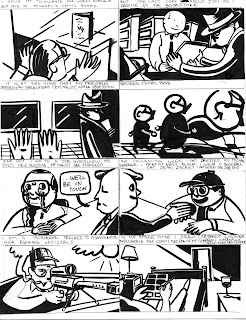
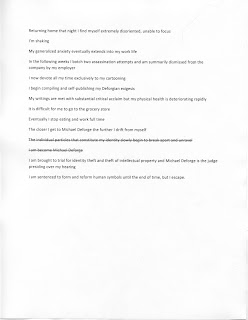
I left the four panels on the final page of the comic blank, I intend to improvise a scene depicting the main character's transformation into Michael Deforge that will stylistically be similar to some of the sketches I have attached below. I was also considering the idea of collaging the drawings below directly into the finished comic.


Friday, October 2, 2015

Thursday, October 1, 2015

SPX Panels

Summary 1:
Life, Death, Comics, and Everything in Between was a panel consisting of Jennifer Hayden, creator of Story of My Tits, Derf Backderf, creator of My Friend Dahmer, and Frederick Peeters, creator of Blue Pills ). The topics discussed were mostly about those specific works and other comics deriving from personal life experiences, and how to depict such experiences effectively. Backderf offered some interesting bits of advice concerning character development as self portraiture, saying “You can’t be afraid to portray yourself as an asshole. You have to service the story”. Hayden added, “You always have to look worse than whoever you’re depicting. You have to be harder on yourself”.  They each had differing answers when questioned about depicting real life characters. The views were split between an obligation to the individuals to ask each living person for permission and sometimes changing names and details, versus an obligation to the honesty of the work through the literal representation of the reality of the situation.

Summary 2:

SPX Spotlight on Luke Pearson, creator of Hilda and the Mighty Giant, Philippa Rice, creator of Soppy, Sam Bosma, creator of Fantasy Sports, and Kali Ciesemier, MICA alum and creator of All My Anime Boyfriends, was a pretty general panel about the artists’ lives, work, and artistic processes. One interesting aspect of this panel was the fact that they were a pair of working artist couples (Luke with Philippa, and Sam with Kali). They spoke for a bit about working and living with another comic artist/ illustrator, and they all generally advised to try and work separately from another, so as to keep their work fresh and not too heavily influenced by a particular person’s taste or style. I found this relevant as an art student and found it applicable to anyone living in a community of other artists who may find it easy to get caught up in a style shared by any particular social group. On a similar note, they also discussed some helpful ways to get out of a creative rut, such as a change of scenery, change of social group and opinions, as well as making a conscious effort to examine the kind of work you like to consume.

SPX

Panel 1 Summary: Scott McCloud
Scott McCloud is well known for his analytical approach on his comic theory book, Understanding Comics. He continues this theoretical discussion by naming four general “campfires” of artists. The classicalist deals with beauty, craft, and working the hand. The animist is a pure storyteller, focusing on the audience. The formalist goes over research and development; that is, their goal is to understand how the form works. Finally, the iconoclast believes that honesty trumps everything; it is okay if the art is rough, because the authenticity of humanity is the most important. McCloud discusses how artists often occupy more than one of these categories, and that often combinations of opposites (such as classicalism with iconoclasm) can result in interesting products.
In addition, he notes contemporary trends, one of which includes the rise of unapologetic content and lowbrow art in achieving a sort of honesty.  He also notes the rise of the comic as a legitimate art form in recent years, and the concern that their popularity could kill its vitality when put into galleries. At the turn of the century, the rise of the web is also contributing to comic distribution and creation. In fact, he drew The Sculptor entirely on Photoshop.
McCloud continues the panel by analyzing The Sculptor. A major theme is the atheist oblivion with which the main character, David Smith, struggles throughout the graphic novel. In doing so, McCloud employs several techniques of storytelling. For example, the Gestalt effect (where the part represents the whole) -- rather than drawing Times Square literally, he represents the area with a cacophony of voices discussing subjects typically heard there. In addition, McCloud discussed how the panel serves as a container of time, and that time subsequently becomes a liquid; without borders, a panel can become a literal bleed of time, extending the moment contained within it. Other structural strategies used include the macro as well as micro narratives.


Panel 2 Summary: It’s a Small, Small, Small Press World
Entrepreneurs in the self-publishing business discuss how they got into the venture, the type of work they handle, and advice for comic book artists wanting to self-publish.
These entrepreneurs stated that they began because they enjoyed getting people to join their interest and spreading the fever of comics. One said, “There are some things I don’t do, but really love” – publishing others’ works is a good way to have all those tastes and talents to come into one’s own fold.
They stated that artists who work with them have different levels of experience in publishing their work – for example, with cleaning, printing, and so forth. These entrepreneurs help these artists with what they do not know to help them create physical copies of the final product. In addition, artists go to them to get published because it can be very daunting to have to promote one’s own work.
In finding whom to publish, while they must fill up slots in their publishing schedule, it is not difficult to find talent. Sometimes they find people based on an aesthetic. In terms of web publishing, deciding on whom to publish is an easier call to make because there is no need to handle the financing and distribution of the physical copies that may remain unsold.
In determining the number of copies to order, there are several different strategies:
·      Print as many to sell throughout one year.  (Be careful on overshooting the numbers: you may not sell it all.)
·      Another way to test the waters is print on demand (i.e. printing a smaller amount at a time, such as 60 copies.)
·      Try to determine the number of copies you need to the amount of money you are willing to spend on it.

They also gave advice for comic artists just getting started: a long, 300-page novel is hard, and results in the artist working in silence for a few years following outdated ideas. Rather, output shorter, 20-page stories to continue producing, improving, and to receive feedback.